An official website of the United States government, Department of Justice.
Here's how you know
Official websites use .gov
A .gov website belongs to an official government organization in the United States.
Secure .gov websites use HTTPS
A lock (
) or https:// means you've safely connected to the .gov website. Share sensitive information only on official, secure websites.
The National Institute of Justice (NIJ), through the NamUs program, provides funding and support to perform nuclear DNA testing, including Y-STR, and mitochondrial DNA analyses for missing and unidentified person cases from across the country.
NamUs is partnering with recognized ISO accredited CODIS laboratories across the country that are capable of developing and uploading mitochondrial DNA profiles to CODIS.
Keep reading below for a list of Frequently Asked Questions related to DNA submissions and analyses.
NamUs is partnering with recognized ISO accredited CODIS laboratories across the country that are capable of developing and uploading mitochondrial DNA profiles to CODIS.
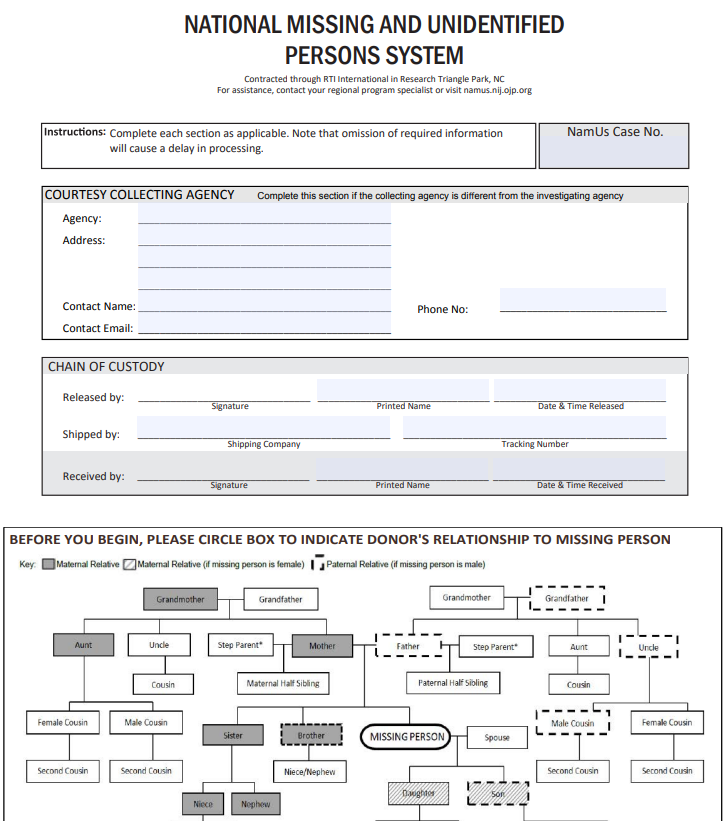
The following form is designed to assist criminal justice personnel in the collection of DNA samples from family members. Please see the FAQs below for more information regarding DNA collection and testing.
To submit your request for DNA testing, please visit the Contact Us page and select “Biometric Support” in the Nature of Inquiry dropdown menu.
Family Reference Samples
Family members of missing persons are asked to provide DNA samples that are profiled and uploaded to the National DNA Index System, in an effort to locate missing persons through DNA database searches. These samples, known as Family Reference Samples, are voluntary DNA submissions that are used only in the search for a missing loved one.
The National DNA Index System, or NDIS, is part of the Combined DNA Index System (CODIS). NDIS contains profiles contributed from federal, state, and local participating DNA laboratories across the country. The DNA profiles uploaded to NDIS are organized into indices, such as the Convicted Offender index. Direct profiles from a missing person, which are derived from items such as toothbrushes or tissue samples, are uploaded to the Missing Person index of CODIS. Profiles for unidentified decedents are uploaded to the Unidentified Human index of CODIS. Profiles from family members are uploaded to the Relatives of Missing Persons Index.
Individuals who provide Family Reference Samples in an effort to locate a missing loved one will have their DNA profiles uploaded to the Relatives of Missing Persons index of CODIS, which is searched only against the Unidentified Human index of CODIS. Family reference profiles are not searched against any of the criminal indices, such as those containing profiles of convicted offenders or unknown suspects.
A family member cannot collect or submit personal DNA samples for profiling and upload to CODIS. All samples must be collected by criminal justice personnel who verify the DNA donors' identity, collect the samples, and contact their assigned NamUs Regional System Administrator to request testing.
Submit a request for assistance or information by visiting the Contact Us page and selecting "Biometric Support (DNA/Dentals/Prints/Anthro/Analytical)" in the "Nature of Inquiry" field.
A family reference sample must be collected by a law enforcement officer, medical examiner, coroner, or other medicolegal investigator. All family reference sample requests must be submitted with a completed DNA Sample Collection Form.
First-degree relatives (parent, full sibling, or child) are most beneficial for Short Tandem Repeat (STR) DNA comparisons. Second-degree relatives (half-sibling, aunt, uncle, grandparent, etc.) may be useful for limited STR comparisons, as well as for Y-STR or mitochondrial DNA comparisons; however, first-order relatives are always preferred when available.
In order for proper searching to take place in CODIS, and for potential associations to be identified, DNA profiles from at least two family members should be collected for every missing person case. If no first-degree relatives are available, additional family reference collections may be required. If you have questions regarding DNA collections in a particular case, contact your NamUs Regional System Administrator.
If siblings share only one parent, and if they are half-siblings, it is important to note if they are paternally or maternally related on the DNA submission paperwork. This information will allow the laboratory to ensure that proper searching takes place within CODIS. For instance, half-siblings who share the same mother will be utilized as both a nuclear and mitochondrial DNA reference.
Once your assigned Regional System Administrator has approved your case for DNA analysis, and you have submitted your samples to the assigned laboratory, the expected turn-around-time is 120 calendar days. However, factors may impact this timeline, including additional testing required due to sample type and quality.
Yes. We are able to process a sample from a deceased individual as long as the obtaining officer completes and signs the Affidavit of Voluntary Collection. This form can be obtained by contacting the Regional System Administrator assigned to the case.